UPDATE: Slashdot coverage
Richard Stallman gave a talk at Georgia Tech on Janurary 23rd, 2026. Oddly enough, they had it in the Scheller College of Business, which is quite far from the College of Computing building. (The Howey Physics Building is right next to the College of Computing building.)
Coverage:
Apparently Stallman had not given a talk in the United States for a very long time, and had never actually visited Georgia Tech. I’m glad he visited!
The venue was almost entirely full. Me and a few others showed from Physics, and many of them did not know about him at all beforehand. Comments after the talk by them commended his extremely consistent philosophy, although they might not follow it themselves.
The talk started with a 14 minute recording of his TedX Talk outlining Free software, followed by him discussing some discussion of the negatives of proprietary software.
The title of the talk was “Free/Libre Software1 and Our Freedom: Our Shield Against Many Injustices.” Much of the talk was kinda rambling and hard to follow, as evidenced by me having to explain to others afterwards what he meant. Much of it consisted of examples of how proprietary software can do bad and undesirable things, and how free software prevents this. It could have done with more relatable examples. The best way I would probably explain to others why free software is good in the intended framework of the talk is:
Free software allows you to use your computer the way you want to, and allows you to help others use their computers the way they want to. Despite how ubiqitous and essential computers are nowadays, most do not allow you to do this.
- Imagine if Netflix removing a series didn’t prevent you from watching it somewhere else.
- Imagine if you didn’t have to put up with Spotify changing its algorithm.
- Imagine if Amazon did not have the ability to delete eBooks from your device.
- Imagine if you could share logins to Netflix without having to worry if they will crack down on it and leave you locked out of your account.
- Imagine if you could leave your computer on without worrying if Microsoft will push an update against your will.
- Imagine if you could use social media without worrying if the platform is controlled by some foreign (or domestic) adversary.
- Imagine if you could write about controversial topics without worrying that Google or Facebook will delete your post.
- Imagine if you didn’t have to worry about some app updating and removing some feature you like, because you could add it yourself, or have someone programmer who likes that feature add it back.
This is the vision of free software. A world where you can control your computer, and help others control theirs, and not let your computer control you.
The talk was followed by a Q&A section, where people submitted questions on note cards (the first time I have ever seen this). Many of the questions were about practical matters, such as how you make money if you write free software, and how one lives when so many things require you to use or interact with proprietary software. Questions like that last one was the most interesting part of the talk for me, as he discussed how he orders airplane tickets and schedules doctor’s appointments by phone or in person. That this was even still possible surprised me. It seems like something that died out as outdated, like paying for magazines by sending money orders in the mail.2
This got me thinking: how many people in the audience thought that you could do that, and how many people would? Georgia Tech is situated in Midtown Atlanta, a place with Waymos, rental bikes, and cashless restaurants. The Department of Education says that 86% of the students at Georgia Tech are “affluent” (in the middle class or above). If are a freshman, you were likely born in 2007 and you entered elementary school in 2013, middle school in 2018, and high school in 2021. Many of the undergraduates in the audience don’t know a world where you didn’t constantly have to use proprietary software.
I barely know that world myself. I have memories of my parents making doctors appointments by phone, of buying train tickets in cash, of having to wait at the airport without the ability to call and text the person picking you up. But I never did any of that myself. I grew up in a world where computers were already everywhere. I was required to use a computer in first grade in 2007, for “Accelerated Reader” tests, and my school district and school had websites that we would have to look at to learn information about the school year.
As a consequence of being raised by people very resistant to change who were employed by an entity very resistant to change (a university), I lived in a world where people weren’t expected to have a computer on them at all times longer than most other people my age. My experience of that life (and the knowledge of people who try to live similarly) makes it much easier to choose to live that life even if it alienates me from others. But telling a freshman in the audience that has no knowledge of that life first-hand that they should live like that is like telling your average American to become Buddhist monk. It’s not like they can’t do so, physically, but it’s so foreign to them and to those around them that they would have to make major sacrifices for a life that they is just not as clear to them as it is to me (or Stallman).
Of course, I don’t live like Stallman, even though I live closer to that life than most people. I use non-free Javascript to order airplane tickets and make doctors appointments, even if I refuse to use Discord or WhatsApp. I have a smartphone (running PostmarketOS with a mostly mainline-Linux kernel) even if I almost never use it.
So how should we feel about the ability for people to control their digital lives in the future? One student approached Stallman after the talk and asked him what made him optimistic about the future of free software. Stallman’s reply (paraphrasing) was “Oh no, I’m not optimistic. But while I’m still alive, I might as well keep on fighting. If you give up, then you just lose.”
This statement stuck with me more than anything Stallman said during the talk. It’s noble to fight on, even if you are not optimistic about winning. But I think we should be optimistic. There were worse periods in the history of computing. Desktop Linux3 used to be a complicated mess to install and maintain: many (but not all) of the issues have been smoothed out. Free video and audio codecs now exist and work very well. You used to have to buy compilers, while nowadays the best compilers like Clang, GCC, rustc are free. A decade ago alternatives to Facebook and Twitter were too small to be relevant, and now federated social media like Mastodon is large enough to be usable by those like famous mathematician Terence Tao.
Progress is sometimes slow. Proprietary software can run a mile before free software can put its shoes on. But these alternatives were made by people who believed that this software could work, and that it could be better than non-free alternatives. They worked at it for years even if people thought that it was a waste of time. The fruits of their labor eventually bore fruit, and we are better off because of it.
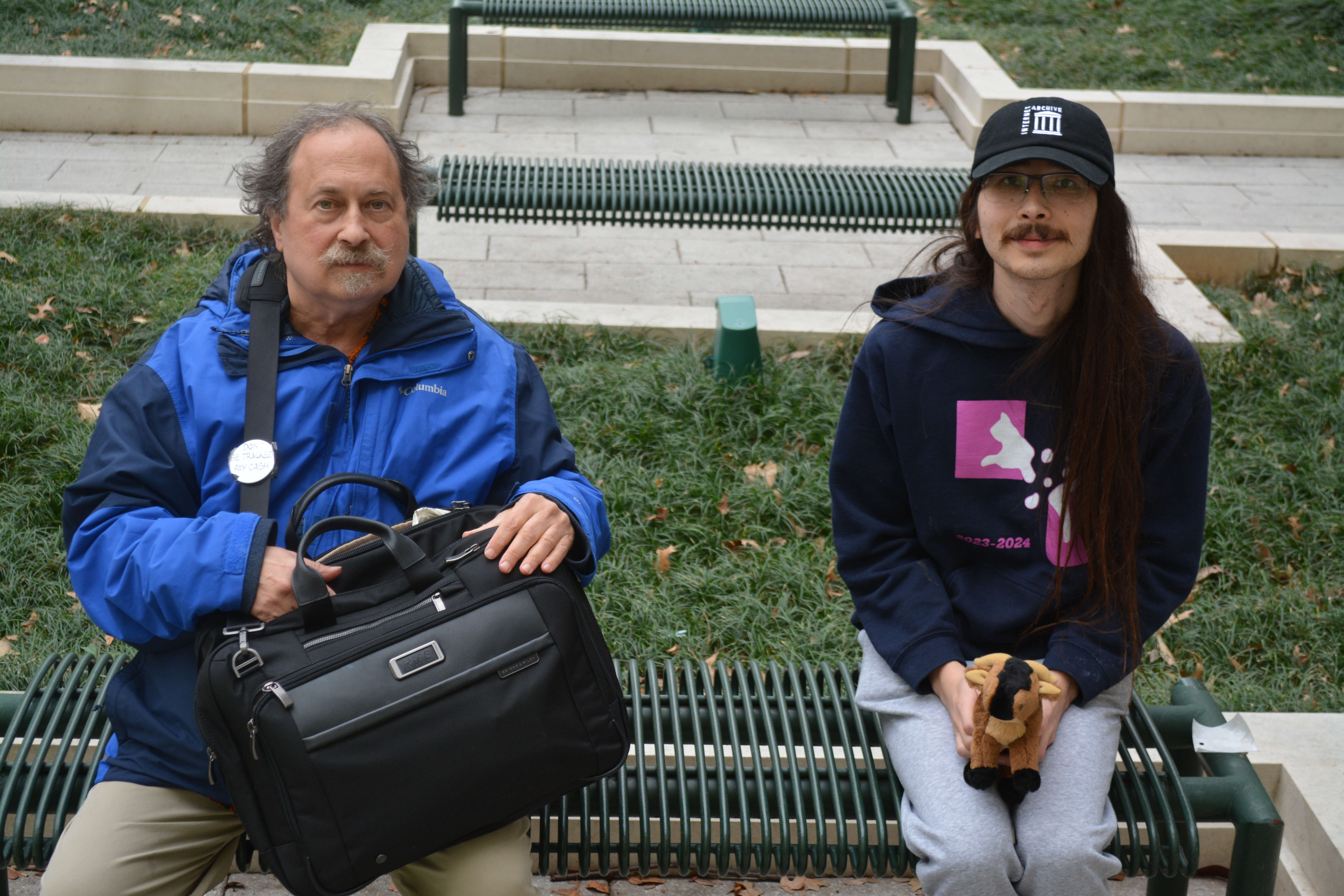
After the Q&A was an auction. I won a GNU, signed by Richard Stallman himself. I later got a picture with him:
Happy hacking!
-
Free as in the freedom to use, study, modify, redistribute, and modify a computer program in any way you wish. ↩︎
-
Update on January 27th: I got a Dover Publications coloring book catalog in the mail that had a mail-in order form on it. So I guess this practice is not as dead as I expected. ↩︎
-
I use Alpine Linux, which has no GNU components, and thus should never be called “GNU/Linux.” The considerations here apply to systems like Trisquel just as much as they do to Alpine. ↩︎